
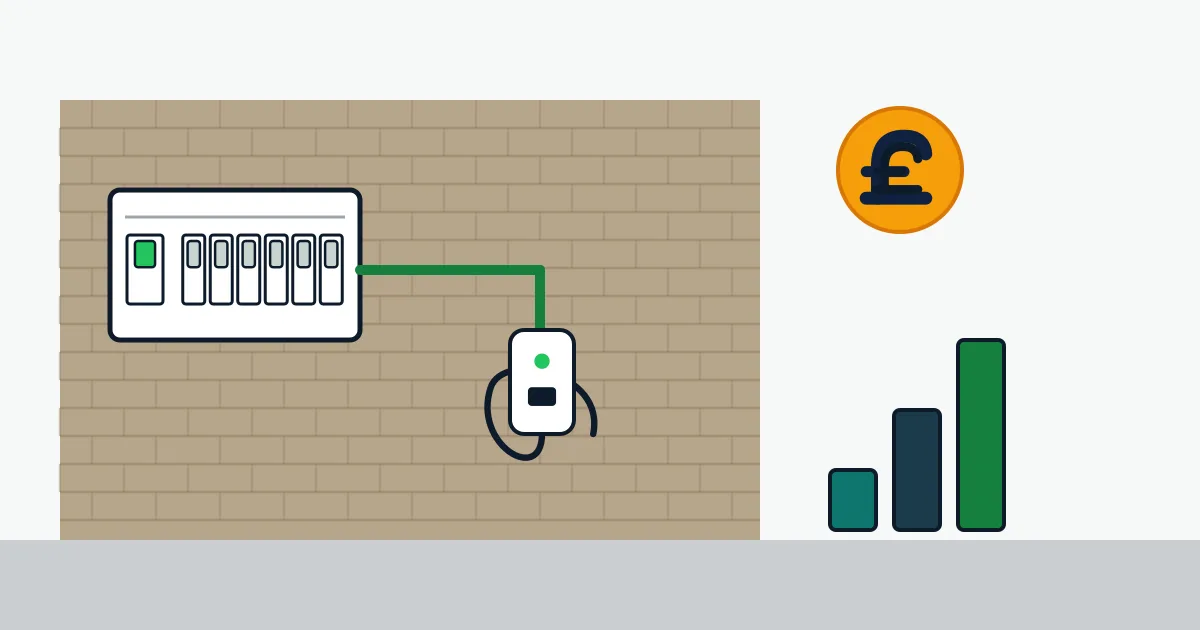
A 7kW charger is the standard home charging speed in London, and it explains most of what people mean by a home chargepoint. 7kW EV charger installation typically costs between £850 and £1,400 fitted. The power rating is not what separates a cheap job from a dear one. The size of your incoming supply and how far the cable has to travel do.
What the rating means
A 7kW (strictly 7.4kW) charger draws about 32 amps on a single-phase supply. On a typical electric car that is an overnight top-up from empty on most batteries, and a few hours for a normal daily commute. It needs a dedicated 32A circuit with its own protection. That is more demanding than it sounds, because a modern house can already be using a good share of its supply on an electric shower, an oven or a heat pump.
What you can expect to pay
Typical 7kW EV charger installation costs in London, supplied and fitted
| Job size | What it usually involves | Typical cost |
|---|---|---|
| Short run | Charger within about 5m of the consumer unit | £850–£1,050 |
| Typical run | 10 to 20m cable route, surface-clipped or buried | £1,050–£1,250 |
| Long or protected run | Armoured trench run, earth rod or protective device needed | £1,250–£1,400 |
As always these are guide figures. The EV charger cost calculator lets you compare the same job size across the other services.
Why supply matters more than the unit
Before fitting a 7kW charger, the electrician checks the main fuse rating, the earthing arrangement and the maximum demand on the property. In some London streets the supply is shared or looped with a neighbour. That can mean a notification, a fuse upgrade or a wait for the network operator, none of which is in the price of the charger. Our guide to supply, fuses and DNO checks in London goes through the usual cases.
- Earthing. Many older properties have a protective multiple earthing supply, and the regulations require extra protection against open-PEN faults for outdoor chargers. Options include a device built into the charger or an earth rod, and which one fits depends on the site.
- Load. If the survey shows the supply is close to its limit, the installer may suggest a charger with load management, or a lower charging rate.
- Phase. Most houses have a single-phase supply and a 7kW charger is the right fit. Three-phase is uncommon in homes and unnecessary for a standard 7kW unit.
- Cable. The cable between the consumer unit and the charger is sized for the load and the length of the run. A longer run needs a thicker cable, which costs more.
Almost every home charger on sale is rated at 7kW, whether it is tethered, untethered or smart. If one quote says 7kW and another says tethered smart 7kW, they are not the same product. Ask each installer to state the full specification so you compare like with like. Our guide to tethered, untethered and smart chargers covers the differences.
Before you accept a quote
- Does it include the survey and a written design for the circuit?
- Is the network operator notification included, and who is responsible for any charge that results?
- Which protective devices are included for the earthing arrangement?
- What certificates will you receive?
Frequently asked questions
Is 7kW fast enough for home charging?
For most drivers, yes. Seven kilowatts adds roughly 25 to 30 miles of range an hour, and the car is usually plugged in overnight anyway. Drivers with a very large battery or a long daily mileage may notice it, though a faster home charge needs a different supply.
Do I need a three-phase supply for a 7kW charger?
No. A 7kW charger runs on a normal single-phase domestic supply. Three-phase only matters for faster chargers, and most London homes would need a network upgrade to support one.
Will my fuse box cope with a 7kW charger?
It depends on the main fuse, the other loads in the house and the condition of the consumer unit. The installer works this out at the survey, and may recommend a charger with load management if the margin is tight.
Why do two 7kW quotes differ so much?
Usually because of cable length, the route, the protective devices included and the quality of the charger. Ask each installer to itemise the same things.
Ready to talk to a 7kW EV charger installation specialist?
Get Free Quotes →