
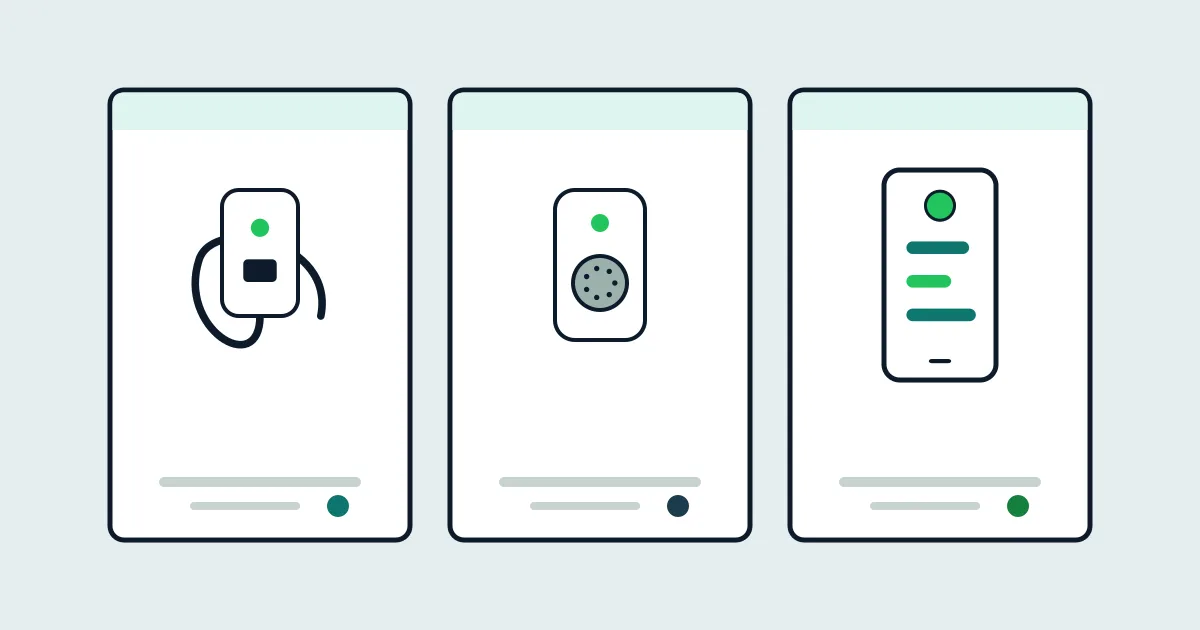
These three words are often listed as if they were rival options, but they describe different questions. Tethered and untethered are about the cable. Smart is about the software. A charger can be tethered and smart, or untethered and not, and almost every charger sold today is rated at 7kW. It helps to settle each question separately.
Tethered or untethered: the cable
Tethered and untethered chargers compared
| Tethered | Untethered | |
|---|---|---|
| The cable | Fixed to the charger, usually 5m, 7.5m or 10m | You bring your own Type 2 lead |
| Convenience | Pull it out and plug in | Fetch the cable from the boot each time |
| Appearance | Holster and lead on the wall | A neater unit with no lead on show |
| Changing car | Fixed lead stays; check the new car's connector | Swap the lead if needed |
| Shared space | One lead, one car at a time | Each household uses its own cable |
| Typical London installed cost | £900–£1,600 | £850–£1,500 |
Our cost guides for tethered and untethered chargers go into the numbers. As a rule of thumb, a household with its own drive and one car tends to prefer tethered. A front wall on a terrace, a shared drive or a household that expects to change car often points to untethered.
Smart: the software
A smart charger connects to an app, lets you set a charging schedule and can report usage. Some add load balancing against the rest of the house, and some match charging to solar generation. Chargers sold for use at home in Great Britain generally have to include basic smart functions anyway, so the real question is how many of the extras you want. We cover typical prices in our smart charger cost guide.
Which suits which London home
- Interwar semi with a drive. A tethered or untethered unit on the side wall or garage both work. Tethered is easier if only one car uses it.
- Victorian terrace with a front garden turned into a drive. Untethered looks tidier on the front elevation, and a smart unit helps if the meter is on the other side of the house.
- Mews or garage. A tethered unit inside the garage keeps the lead out of the weather.
- Flat or allocated bay. Often a shared supply, so load management matters more than the cable type. Look at the flats service.
- Home with solar panels. Look for a smart unit that can read your generation.
The electrical work for all three is much the same, and you can usually change your mind about the cable or the smart features before the installer orders the unit. What you can't easily change afterwards is the position on the wall.
Frequently asked questions
Is a tethered charger better than an untethered one?
Neither is better overall. Tethered is more convenient day to day, and untethered is neater and more flexible if you change car or share the space.
Do I need a smart charger?
Home chargers sold in Great Britain generally have smart functions built in. How far you use them depends on your tariff, any solar panels and your own preference.
Can a charger be tethered and smart?
Yes. The cable type and the software features are independent, and many chargers combine them.
What cable do I need for an untethered charger?
A Type 2 charging cable whose current rating suits the charger, in a length that reaches your car's port. Check the car's manual for its maximum charging rate.
Ready to talk to a 7kW EV charger installation specialist?
Get Free Quotes →