
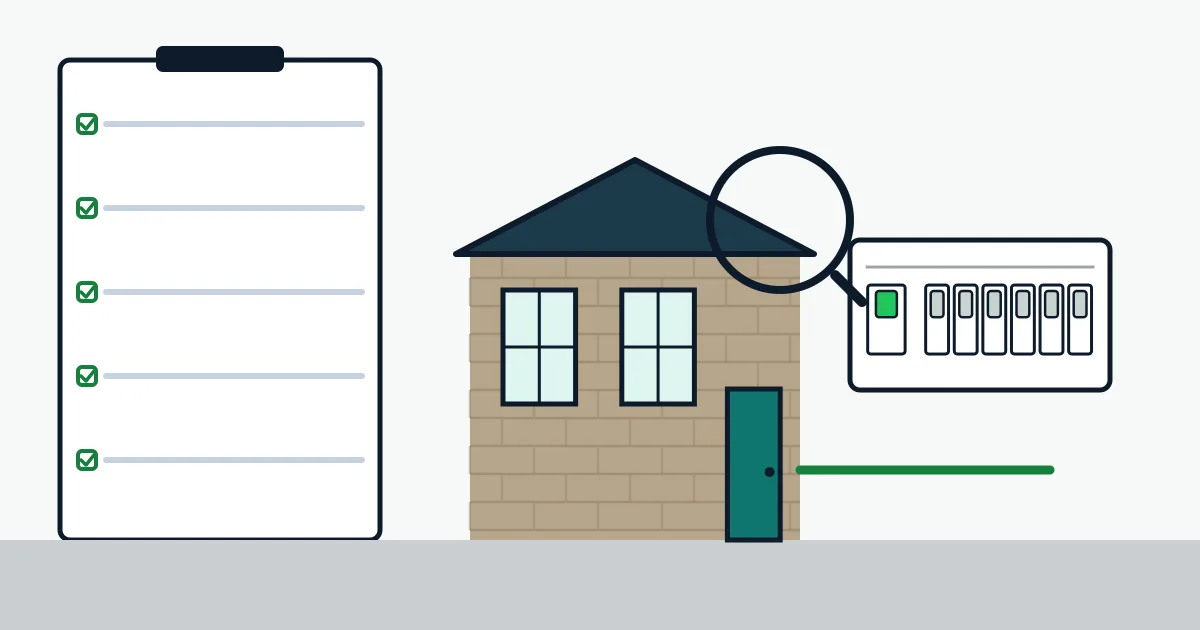
Most London homes can take a charger. A handful can't, or need extra work first, and it is far cheaper to find that out before you order a car or sign a quote. This is the checklist a survey works through, in the order that tends to settle the question fastest.
1. Where will the car sit?
A standard home EV charger needs a space you control: a drive, a garage or an allocated bay. If you park on the street, a cable across the pavement is not an accepted arrangement, though some boroughs have trialled approved channels. Check with your council. If you have a front garden but no dropped kerb, you may need the council's permission to create a crossover before the car can park there at all.
2. Where is the meter and the fuse box?
In many London houses the meter and consumer unit are in the hall, under the stairs or in a meter cupboard, which can be a long way from the parking space. The shorter the route between them, the cheaper the job. Note whether the cable could run through the garage, along an outside wall or across the garden, and whether any part of that path is paved.
3. What does the supply look like?
A charger runs at high load for hours, so the electrician checks the main fuse, the earthing arrangement and how much of your supply the rest of the house uses. Photos of the meter, the main fuse and the consumer unit, taken with the covers closed, help an installer give a sensible indicative price before the visit. Please don't open any electrical equipment to collect information. Our overview of 7kW charger costs explains why supply matters so much.
4. Do you need anyone's permission?
- Freeholder or landlord, if you rent or hold a lease
- The council, if the cable or the unit affects the highway or you need a crossover
- Neighbours, if the supply is shared or the cable crosses a shared drive
- Planning, in some conservation areas and for listed buildings
5. What do you want from the charger?
Decide roughly whether you want a fixed lead or your own cable, and whether smart scheduling or solar matching matters. Those choices do not decide whether the install is possible, but they change the quote. See our guide to tethered, untethered and smart chargers for a quick way to settle it.
Drive and meter close together, modern consumer unit: expect a short-run job. Terrace with the meter in the hall and a paved front garden: expect a long run. Flat or shared car park: look at the flats service and the flats cost guide first.
How to check your home before asking for EV charger quotes
- Measure the route
Pace out the distance from the meter or consumer unit to the spot on the wall where the charger would go, and note any walls, paving or doors in the way.
- Photograph the supply
With the covers closed, photograph the meter, the main fuse and the consumer unit so an installer can see their condition.
- Check where the car will park
Confirm the space is yours to use, and that the charging port will reach the charger with the car parked either way round.
- List who needs to agree
Write down any landlord, freeholder, council or neighbour whose permission the route or position will need.
- Note other big loads
Make a list of an electric shower, heat pump, hot tub or second car so the installer can check the supply copes.
Frequently asked questions
What does an EV charger survey check?
The parking position, the cable route, the main fuse, the earthing arrangement, the condition and spare capacity of the consumer unit and the other loads on the property. Some installers start from photos and confirm on site.
Can I have a charger if I have no driveway?
A standard home charger needs a space you control. If you park on the street, ask your council about public chargers or any approved cross-pavement scheme. A lead laid across the footway is not an accepted arrangement.
Does my fuse box need replacing?
Not always. The electrician checks whether there is a spare way and suitable protection. A replacement, or a small separate board, is sometimes recommended, and any such cost should appear in the quote.
How long does the survey take?
Usually under an hour on site. A photo-based assessment can be quicker, though a firm price normally follows a visit.
Ready to talk to a home EV charger installation specialist?
Get Free Quotes →