
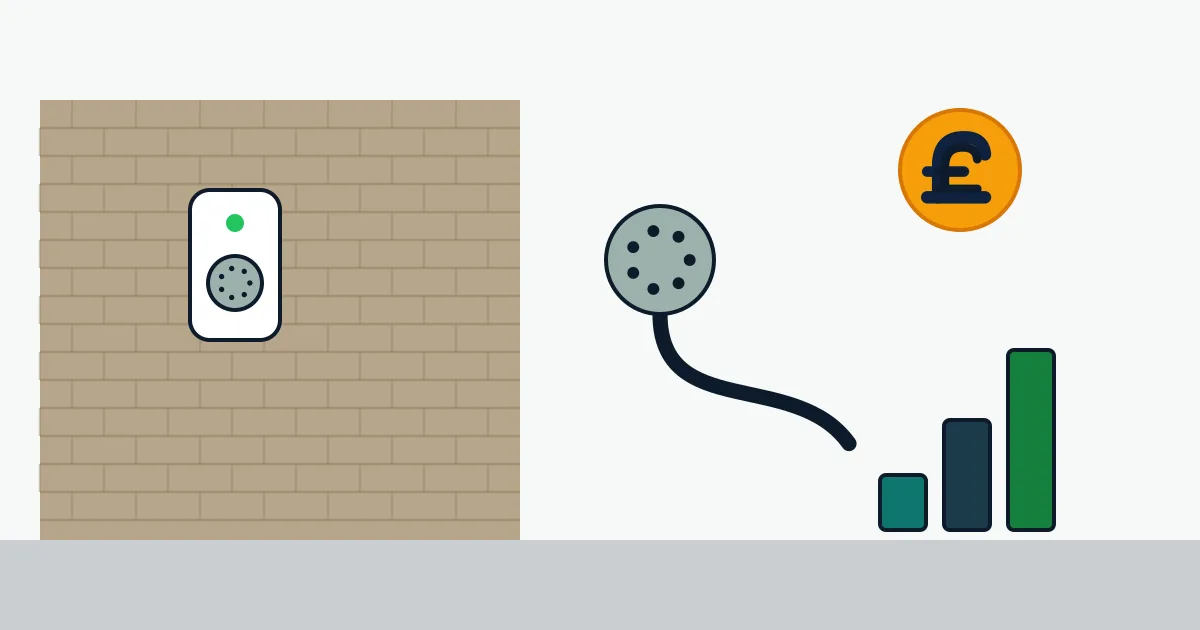
An untethered charger has a socket on the front and no fixed lead. You carry your own Type 2 cable and plug it in when you park. Untethered EV charger installation in London typically costs between £850 and £1,500 fitted, and the unit tends to be the neatest and least obtrusive on the market.
What you can expect to pay
Typical untethered EV charger installation costs in London, supplied and fitted
| Job size | What it usually involves | Typical cost |
|---|---|---|
| Short run | Wall unit near the fuse box, you supply the cable | £850–£1,050 |
| Longer or front-of-house run | Cable routed to a front wall or around a bay window | £1,050–£1,250 |
| Pillar-mounted or shared drive | Free-standing unit, trench run or access shared with a neighbour | £1,250–£1,500 |
These are guide figures, and your own cable is an extra cost. A good Type 2 charging lead typically costs from around £100 to £250 depending on length and quality, so factor that into the comparison with a tethered charger.
Why people choose untethered in London
- Front-of-house walls. A socketed unit is less visible than one with a coiled lead hanging beside the front door, which matters on a terrace or in a conservation area.
- Shared drives. Two households can use one unit with their own cables, or two units can sit side by side.
- Changing cars. If your next car has a different connector or inlet position, you buy a new lead instead of a new charger.
- Security. The cable travels with you, so it can't be unplugged or tampered with on the street side.
The trade-off is that you handle the cable every time. A wet or muddy lead goes in the boot and has to be stored somewhere. If that bothers you, a tethered unit is easier day to day.
What pushes the price up
- Distance from the fuse box. As with any home charger, this does more to the price than the unit.
- Hardstanding. Digging up a paved front garden to run cable costs more than clipping along a wall.
- Mounting. A free-standing pillar needs a base and a protected cable route.
- Listed or conservation-area frontages. Where the wall position is limited, the run gets longer.
- A tight supply. If load management or an upgrade is needed, the job moves into the dearer band.
A socketed unit on a front wall is the most common request from households that park on the street, but a cable across the pavement is not a standard arrangement. Read our guide to EV charging without a driveway before assuming it will work.
If you are comparing quotes, see our overview of tethered, untethered and smart chargers. The installation itself is much the same as for a home EV charger.
Frequently asked questions
Is an untethered charger cheaper than a tethered one?
The unit is often a bit cheaper, but you must buy a cable. Once you add a decent lead, the total is usually similar.
What cable do I need for an untethered charger?
Almost all new cars use a Type 2 connector at the charger end. Check that the cable's current rating matches the charger, and choose a length that reaches your car's port comfortably.
Is it safe to leave the cable outside?
Better not to. Most people store the lead in the boot or a dry box, because a charging cable left on the ground can be run over or damaged.
Can two cars share one untethered charger?
They can take turns on one unit, each with its own cable. Some households fit two units instead, and the installer will need to check the supply can cope.
Ready to talk to an untethered EV charger installation specialist?
Get Free Quotes →